9.1 - Low-Pressure Appliance Fundamentals
Module: Type III Low-Pressure Appliances
Regulatory verification date: August 13, 2026
Primary current authority: 40 CFR §§ 82.152 and 82.161 and current EPA Section 608 Type III test topics
Course role: Establishes the equipment, pressure, refrigerant, and leak-direction concepts needed before studying Type III chiller components, purge units, leak testing, recovery, charging, evacuation, and safety
Learning Objectives
After completing this section, a student should be able to:
- Define a low-pressure appliance using the current Section 608 definition.
- Explain why low-pressure appliance service falls under Type III certification.
- Identify low-pressure centrifugal chillers as the principal Type III equipment example used for EPA examination preparation.
- Describe the basic evaporator–compressor–condenser operation of a centrifugal chiller.
- Explain why portions of a low-pressure chiller commonly operate below atmospheric pressure.
- Explain why leaks under subatmospheric conditions can draw air and moisture into the refrigerant circuit.
- Explain why refrigerant can leak out when local internal pressure becomes greater than atmospheric pressure.
- Distinguish the EPA term low-pressure appliance from the refrigeration-cycle terms high side and low side.
Introduction
Type III is the Section 608 certification category for low-pressure appliances.
For most students, the central Type III example is the low-pressure centrifugal chiller used to produce chilled water for large buildings, campuses, hospitals, central plants, and industrial facilities.
A Type III chiller still performs the same basic vapor-compression refrigeration functions introduced in Module 4:
absorb heat at low refrigerant pressure
→ compress refrigerant vapor
→ reject heat at higher refrigerant pressure
→ reduce refrigerant pressure
→ repeat the cycle
What makes Type III service different is the refrigerant pressure level. At typical operating conditions, important portions of a low-pressure chiller can operate below atmospheric pressure. Under those conditions, a leak may draw air and water vapor inward instead of allowing refrigerant to leak outward.
Internal pressure < atmospheric pressure
→ AIR + MOISTURE CAN LEAK IN
However, the appliance is not guaranteed to remain below atmospheric pressure at every location and under every condition. If local refrigerant pressure rises above atmospheric pressure, refrigerant can escape through the same type of opening.
Internal pressure > atmospheric pressure
→ REFRIGERANT CAN LEAK OUT
This pressure-direction relationship is the foundation for the purge, leak-detection, recovery, freeze-prevention, charging, evacuation, and safety topics developed throughout Module 9.
Key Concepts
1. Current Section 608 Definition of a Low-Pressure Appliance
Source: 40 CFR § 82.152
A current Section 608 low-pressure appliance uses a refrigerant whose liquid-phase saturation pressure is below 45 psia at 104°F.
The current regulation lists examples including:
- R-11.
- R-113.
- R-123.
- R-245fa.
The classification relationship is:
Liquid-phase saturation pressure
< 45 psia at 104°F
→ LOW-PRESSURE APPLIANCE
→ TYPE III
The regulatory threshold is 45 psia, not 45 psig.
Pressure units and the relationship among gauge pressure, absolute pressure, and vacuum were developed in Section 4.6 - Gauge Pressure Absolute Pressure and Vacuum.
2. Type III Certification Scope
Source: 40 CFR § 82.161
Persons who maintain, service, repair, or dispose of covered low-pressure appliances must hold:
TYPE III
or:
UNIVERSAL
certification when the work is subject to the Section 608 technician-certification requirement.
Type III is therefore determined by the appliance’s refrigerant pressure category, not simply by:
- Chiller physical size.
- Building size.
- Refrigerant charge.
- Compressor horsepower.
- Cooling capacity.
- Location in a machinery room.
3. Centrifugal Chillers Are the Main Type III Examination Example
EPA’s current Type III test-topic list repeatedly refers to low-pressure centrifugal chillers. The centrifugal chiller is therefore the principal equipment model for Type III examination preparation.
A typical water-cooled centrifugal chiller connects two water circuits to one refrigerant circuit.
Chilled-Water Side
Building or process heat
→ chilled water
→ EVAPORATOR
→ refrigerant
The evaporator removes heat from the chilled water.
Condenser-Water Side
refrigerant
→ CONDENSER
→ condenser water
→ cooling tower or other heat rejection
The condenser rejects heat to the condenser-water circuit.
The chilled water, condenser water, and refrigerant are separate fluids under normal operation.
4. A Centrifugal Chiller Is Still a Vapor-Compression System
The basic refrigeration functions are:
| Function | Typical Component | Main Result |
|---|---|---|
| Absorb heat | Evaporator | Refrigerant boils while cooling chilled water |
| Raise vapor pressure | Centrifugal compressor | Compressor adds energy to refrigerant vapor |
| Reject heat | Condenser | Refrigerant condenses while heating condenser water |
| Reduce refrigerant pressure | Flow-control / pressure-reducing path | Liquid refrigerant returns toward evaporator pressure |
Detailed component construction is reserved for Section 9.2.
5. What a Centrifugal Compressor Does
A centrifugal compressor is a dynamic compressor.
A rapidly rotating impeller adds velocity and energy to refrigerant vapor. The diffuser and associated flow path convert part of that velocity energy into increased static pressure.
For Type III exam preparation, remember the result:
Low-pressure vapor
→ centrifugal compressor
→ higher-pressure vapor
→ condenser
The compressor does not normally receive bulk liquid refrigerant.
6. Low-Pressure Appliance Does Not Mean No High Side
The term low-pressure appliance is an EPA refrigerant-pressure classification.
It does not mean:
- The appliance has only one pressure.
- The compressor creates no pressure rise.
- The appliance has no high side.
- Every part of the appliance is always below atmospheric pressure.
A low-pressure chiller still has a lower-pressure evaporator region and a higher-pressure condenser region relative to one another.
Therefore:
LOW-PRESSURE APPLIANCE
≠
NO HIGH SIDE
The terms high side and low side describe regions within the refrigeration cycle. The EPA term low-pressure appliance classifies the appliance according to refrigerant properties.
7. Why the Evaporator Can Operate Below Atmospheric Pressure
A refrigerant boils at the saturation temperature corresponding to its pressure.
To produce chilled water, the refrigerant in the evaporator must boil at a low enough temperature to absorb heat from the chilled-water circuit.
For traditional low-pressure chiller refrigerants such as R-11 and R-123, the saturation pressure at common chilled-water evaporating temperatures is below atmospheric pressure.
Conceptually:
Low required evaporating temperature
→ low refrigerant saturation pressure
→ evaporator can operate below atmospheric pressure
This is a normal operating condition for a low-pressure chiller. It is not, by itself, evidence of an improper service vacuum.
8. Normal Subatmospheric Operation Is Not the Same as Service Evacuation
This distinction is important.
A low-pressure chiller may operate below atmospheric pressure because that is the normal refrigerant saturation pressure at its operating temperature.
That is different from using a vacuum pump during service to:
- Remove refrigerant to a required Section 608 endpoint.
- Remove air and moisture after repair.
- Dehydrate the refrigerant circuit before charging.
Therefore:
NORMAL SUBATMOSPHERIC OPERATION
≠
SERVICE EVACUATION
The current Type III evacuation requirement is developed in Section 9.9.
9. Leak Direction Depends on Pressure Difference
Gas or vapor tends to move from higher pressure toward lower pressure.
If local chiller pressure is below atmospheric pressure:
P_atmosphere > P_chiller
then leakage tends to be inward:
atmosphere
→ chiller
If local chiller pressure is above atmospheric pressure:
P_chiller > P_atmosphere
then leakage tends to be outward:
chiller
→ atmosphere
This is one of the most important conceptual differences between Type II and Type III service.
10. Air Can Leak Into a Low-Pressure Chiller
During subatmospheric operation, an imperfect seal can draw atmospheric air into the refrigerant circuit.
Air introduces gases that do not normally condense at the same operating conditions as the refrigerant. These gases are called noncondensables.
Air infiltration can contribute to:
- Increased purge-unit operation.
- Higher effective condensing pressure.
- Reduced heat-transfer performance.
- Reduced chiller efficiency.
- Increased service and refrigerant-management problems.
The purge unit and noncondensable removal are developed in Section 9.3.
11. Moisture Can Enter With the Air
Atmospheric air contains water vapor. A leak into a subatmospheric chiller can therefore admit both:
AIR
+
WATER VAPOR
Moisture in the refrigerant circuit can contribute to:
- Corrosion.
- Acid formation under unfavorable chemical conditions.
- Oil degradation.
- Refrigerant contamination.
- Reduced equipment reliability.
A leak can therefore be serious even when refrigerant is not visibly escaping.
12. A Low-Pressure Chiller Can Also Lose Refrigerant
A common mistake is to memorize:
Low-pressure chiller
→ air leaks in
and then assume refrigerant can never leak out.
That is incorrect.
Refrigerant saturation pressure rises as refrigerant temperature rises. During warm conditions, shutdown conditions, or at locations where local refrigerant pressure becomes greater than atmospheric pressure:
P_chiller > P_atmosphere
→ refrigerant can leak OUT
The same physical leak can therefore behave differently at different times.
13. Shutdown Does Not Guarantee One Leak Direction
When the chiller shuts down:
- Refrigerant temperatures change.
- Pressure differences in the circuit move toward equalization.
- The refrigerant pressure follows the pressure-temperature relationship associated with its changing temperature.
If the resulting local pressure remains below atmosphere, air and moisture can still enter.
If warming raises local pressure above atmosphere, refrigerant can escape.
Do not memorize:
ON = vacuum
OFF = positive pressure
as a universal rule.
Use the correct relationship:
Leak direction depends on LOCAL INTERNAL PRESSURE
relative to ATMOSPHERIC PRESSURE.
14. A Leak Can Exist Without an Obvious Refrigerant Loss
In higher-pressure systems, technicians often associate leaks with outward refrigerant loss.
In a subatmospheric Type III appliance, a leak may instead create:
- Air infiltration.
- Moisture infiltration.
- Increased purge load.
- Higher noncondensable concentration.
- Reduced system performance.
Therefore:
No visible outward leak
≠
No leak
15. Purge Equipment Does Not Make Leakage Acceptable
Applicable low-pressure chillers use purge equipment to remove accumulated noncondensables.
The basic relationship is:
Leak allows air into chiller
→ noncondensables accumulate
→ purge unit removes noncondensables
Excessive or unusually frequent purge operation can therefore be a clue that air is entering the appliance through a leak.
The detailed purge process is reserved for Section 9.3.
16. Type III Is Not Determined by Compressor Appearance Alone
Not every centrifugal chiller is automatically a low-pressure appliance.
The correct classification sequence is:
Identify appliance
→ identify refrigerant
→ determine current refrigerant pressure category
→ low pressure → Type III
Therefore:
CENTRIFUGAL COMPRESSOR
≠
automatically TYPE III
The refrigerant pressure classification controls.
17. Representative Low-Pressure Refrigerants
The current regulatory definition names the following representative examples:
| Refrigerant | General Context | Type III Point |
|---|---|---|
| R-11 | Historical CFC chiller refrigerant | Listed low-pressure example |
| R-113 | Historical CFC low-pressure refrigerant | Listed low-pressure example |
| R-123 | HCFC strongly associated with low-pressure centrifugal chillers | Listed low-pressure example |
| R-245fa | HFC refrigerant used in some applications | Listed low-pressure example |
This list is not necessarily exhaustive for every modern refrigerant.
For a refrigerant not named in the examples:
- Identify it from reliable equipment or manufacturer information.
- Apply the current § 82.152 pressure definition.
- Confirm whether any other equipment-specific or substitute-refrigerant requirement applies.
Do not classify a modern refrigerant solely because it replaced R-123 or another older refrigerant.
Technical and Regulatory Details
1. Current Type III Classification Summary
| Item | Current Direction |
|---|---|
| Pressure category | Low pressure |
| Classification basis | Liquid-phase saturation pressure below 45 psia at 104°F |
| Examples named in § 82.152 | R-11, R-113, R-123, R-245fa |
| Certification for covered work | Type III or Universal |
| Principal EPA Type III equipment example | Low-pressure centrifugal chiller |
2. Pressure Classification Versus Operating Pressure
The regulatory definition uses a refrigerant property at a specified reference condition:
liquid-phase saturation pressure at 104°F
A field pressure reading depends on present:
- Refrigerant temperature.
- Load.
- Water temperatures.
- Compressor operation.
- System condition.
Therefore:
One operating gauge reading
≠
EPA appliance pressure classification
The complete pressure-category framework was developed in Section 8.2 - Refrigerant Pressure Classifications.
3. Absolute Pressure Matters in Type III Work
Because Type III equipment commonly operates subatmospherically, students must be comfortable with absolute pressure and vacuum.
Near standard atmospheric conditions:
Do not compare a Type III regulatory value with a service-gauge value until the units and reference basis are clear.
4. Why Noncondensables Can Raise Condensing Pressure
In a clean system, condenser pressure is closely connected to the refrigerant’s saturation condition.
If air or other noncondensables accumulate, they contribute their own partial pressure. Conceptually:
refrigerant vapor pressure
+
noncondensable-gas partial pressure
→ higher measured total pressure
For EPA exam preparation, remember the connection:
air infiltration
→ noncondensables
→ increased purge demand / higher head pressure
5. Basic Heat-Flow Picture
A simplified water-cooled centrifugal-chiller heat path is:
BUILDING / PROCESS
↓
CHILLED WATER
↓
EVAPORATOR
↓
REFRIGERANT
↓ compressor adds work
CONDENSER
↓
CONDENSER WATER
↓
COOLING TOWER / HEAT REJECTION
↓
OUTDOORS
The compressor adds work to the refrigerant, so the condenser rejects both the evaporator heat load and the compressor input. A detailed energy balance is not needed for Type III certification preparation.
6. Topics Reserved for Later Type III Sections
| Topic | Section |
|---|---|
| Detailed chiller components, water boxes, rupture disc, oil system, refrigerant monitor | 9.2 |
| Purge-unit operation, excessive-purge leak clues, noncondensables | 9.3 |
| Low-pressure leak-test pressurization and maximum pressure | 9.4 |
| Liquid-first and vapor recovery sequence | 9.5 |
| Water circulation and freeze prevention during recovery | 9.6 |
| Refrigerant dissolved in oil and oil heating | 9.7 |
| Vapor-first recharging and transition to liquid | 9.8 |
| Current Type III evacuation requirements | 9.9 |
| Rupture-disc, machinery-room, monitor, and exposure safety | 9.10 |
Important Terms
Atmospheric Pressure
Atmospheric pressure is the pressure exerted by the surrounding atmosphere. Near sea level under standard reference conditions, it is approximately , although actual local atmospheric pressure varies with elevation and weather.
Centrifugal Chiller
A centrifugal chiller is a vapor-compression liquid chiller that uses a dynamic centrifugal compressor to raise refrigerant-vapor pressure. Low-pressure centrifugal chillers are the principal Type III equipment example in EPA examination preparation.
Centrifugal Compressor
A centrifugal compressor is a dynamic compressor that uses a rotating impeller to add velocity and energy to vapor and a diffuser or associated flow path to convert part of that energy into increased static pressure.
Low-Pressure Appliance
A low-pressure appliance is currently defined in 40 CFR § 82.152 as an appliance using a refrigerant with a liquid-phase saturation pressure below at .
Negative Gauge Pressure
Negative gauge pressure means the local absolute pressure is below atmospheric pressure. In HVAC service this condition is commonly described as operation under vacuum.
Noncondensable
A noncondensable is a gas, such as air in a refrigerant circuit, that does not condense under the normal condenser conditions at which the refrigerant is condensing.
Positive Gauge Pressure
Positive gauge pressure means the local absolute pressure is greater than atmospheric pressure. A leak at such a location tends to allow refrigerant or gas to move outward.
Purge Unit
A purge unit is equipment used on applicable low-pressure chillers to remove accumulated noncondensable gases while minimizing refrigerant loss. Its operation is developed in Section 9.3.
Subatmospheric Pressure
Subatmospheric pressure is an absolute pressure lower than atmospheric pressure.
Type III Technician
A Type III technician is a technician certified under Section 608 for covered maintenance, service, repair, or disposal of low-pressure appliances.
Figures and Diagrams
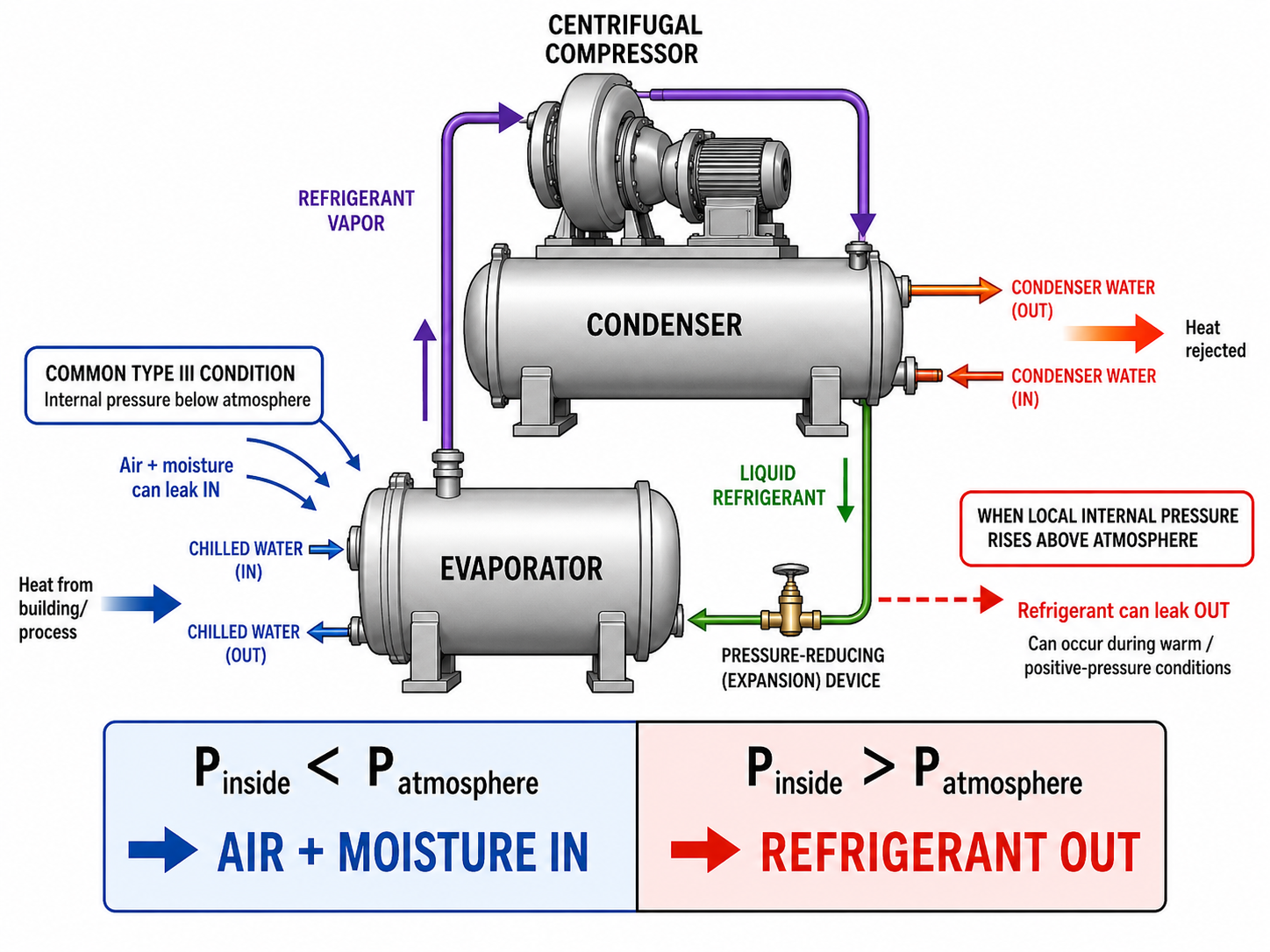
Figure 9.1.1 - Low-pressure centrifugal chiller and the fundamental Type III pressure and leak-direction concepts.
AI-generated instructional figure: It may contain visual inaccuracies. Use the accompanying lesson text and cited authoritative sources to verify technical and regulatory details.
EPA 608 Exam Focus
What Students Must Remember
- Type III applies to covered low-pressure appliances.
- Current § 82.152 defines a low-pressure appliance by a refrigerant liquid-phase saturation pressure below 45 psia at 104°F.
- The regulatory threshold uses psia, not psig.
- Current examples listed in the definition include R-11, R-113, R-123, and R-245fa.
- Low-pressure centrifugal chillers are the principal Type III equipment example in EPA test preparation.
- A low-pressure chiller still has lower-pressure and higher-pressure regions within its refrigeration cycle.
Low-pressure applianceis an EPA pressure category; it does not mean every point is always under vacuum.- Portions of a low-pressure chiller can operate below atmospheric pressure.
- When local internal pressure is below atmosphere, air and moisture can leak into the appliance.
- Air entering the appliance becomes a source of noncondensables.
- A leak can exist even when refrigerant is not visibly escaping.
- When local internal pressure becomes greater than atmospheric pressure, refrigerant can leak out.
- Do not assume every shutdown automatically puts the whole chiller at positive pressure.
- Excessive purge operation can be a clue to air infiltration; detailed purge logic is covered in Section 9.3.
- Type III classification depends on the refrigerant pressure category, not compressor appearance alone.
High-Priority Relationships
LOW-PRESSURE APPLIANCE
< 45 psia saturation pressure at 104°F
→ TYPE III
Pinside < Patmosphere
→ AIR + MOISTURE LEAK IN
Pinside > Patmosphere
→ REFRIGERANT CAN LEAK OUT
Air infiltration
→ noncondensables
→ purge load / higher condensing pressure
Typical Exam Question Patterns
Students may be asked to:
- Identify a low-pressure centrifugal chiller as Type III equipment.
- Identify R-123 as a low-pressure refrigerant.
- Recognize the 45 psia at 104°F classification threshold.
- Distinguish psia from psig.
- Explain why air can enter a low-pressure chiller.
- Identify moisture infiltration as a concern under subatmospheric operation.
- Recognize excessive purging as a possible leak clue.
- Determine leak direction from local internal pressure relative to atmospheric pressure.
- Distinguish a low-pressure appliance from the low side of a Type II appliance.
- Recognize that a low-pressure chiller can lose refrigerant when local pressure becomes positive.
High-Risk Words
Pay particular attention to:
- Low pressure
- Below atmospheric
- Absolute
- psia
- Vacuum
- Air infiltration
- Moisture
- Noncondensables
- Purge
- Shutdown
- Positive pressure
- Type III
Common Mistakes and Confusing Points
Mistake 1: Assuming Type III Means Every Chiller
Type III applies to low-pressure appliances, not every machine called a chiller.
Mistake 2: Assuming Every Centrifugal Chiller Is Type III
Centrifugal describes compressor design. Type III depends on the refrigerant pressure classification.
Mistake 3: Confusing 45 psia With 45 psig
The current low-pressure definition uses 45 psia at 104°F.
Mistake 4: Thinking a Low-Pressure Appliance Has No High Side
The compressor still raises refrigerant pressure. The condenser operates at a higher pressure than the evaporator relative to the refrigeration cycle.
Mistake 5: Treating Normal Subatmospheric Operation as Service Evacuation
Normal refrigerant operation below atmospheric pressure is different from pulling a service vacuum with a vacuum pump.
Mistake 6: Looking Only for Refrigerant Leaking Out
At subatmospheric pressure, air and moisture can leak into the appliance.
Mistake 7: Assuming a Low-Pressure Chiller Can Never Lose Refrigerant
When local internal pressure exceeds atmospheric pressure, refrigerant can leak outward.
Mistake 8: Assuming Every Shutdown Creates Positive Pressure
The actual pressure depends on refrigerant temperature and system conditions.
Mistake 9: Treating the Purge Unit as the Repair for a Leak
The purge unit removes noncondensables. Abnormal purge activity can indicate that leakage should be investigated.
Mistake 10: Treating Air and Moisture as the Same Contaminant
Air contributes noncondensable gases. Moisture is water vapor and creates additional contamination and corrosion concerns.
Mistake 11: Classifying the Appliance From One Gauge Reading
The EPA definition uses the refrigerant’s saturation pressure at the specified 104°F reference condition, not one instantaneous field pressure.
Mistake 12: Assuming the Regulatory Example List Is Exhaustive
For a refrigerant not named in the examples, apply the current definition using reliable refrigerant-property information.
Concept-Check Questions
Question 9.1-1
Under the current Section 608 definition, a low-pressure appliance uses a refrigerant whose liquid-phase saturation pressure is:
A. Below 45 psia at 104°F
B. Below 45 psig at 32°F
C. Between 45 and 170 psia at 104°F
D. Above 355 psia at 104°F
Question 9.1-2
Which Section 608 certification type applies to covered service or repair of a low-pressure appliance?
A. Type I
B. Type II
C. Type III
D. Section 609 only
Question 9.1-3
A low-pressure chiller evaporator is operating below atmospheric pressure and develops a leak. What is the most likely direction of leakage at that location?
A. Refrigerant must always leak outward
B. Air and moisture can be drawn into the refrigerant circuit
C. Chilled water must immediately enter the refrigerant circuit
D. No fluid or gas can move through a leak below atmospheric pressure
Question 9.1-4
Which statement best describes the term low-pressure appliance?
A. It means the appliance has no high side.
B. It means every point in the appliance is always below atmospheric pressure.
C. It is an EPA refrigerant-pressure classification based on refrigerant properties.
D. It is another name for the low side of any Type II system.
Question 9.1-5
Why can air infiltration create operating problems in a low-pressure chiller?
A. Air becomes a noncondensable load that can increase condensing pressure and purge demand.
B. Air automatically improves condenser heat transfer.
C. Air converts the appliance from Type III to Type II.
D. Air permanently lowers atmospheric pressure around the chiller.
Question 9.1-6
Which statement about refrigerant leakage from a low-pressure chiller is most accurate?
A. Refrigerant can never leak out of a low-pressure appliance.
B. Refrigerant can leak outward when local internal pressure rises above atmospheric pressure.
C. Refrigerant leaks outward only when the evaporator is below atmospheric pressure.
D. Shutdown always guarantees that the entire appliance is at positive pressure.
Question 9.1-7
Which refrigerant is specifically listed in the current Section 608 definition as an example used in a low-pressure appliance?
A. R-410A
B. R-22
C. R-123
D. R-23
Question 9.1-8
A technician notices that a low-pressure chiller purge unit is operating much more frequently than usual. At the fundamental level, what condition should be considered?
A. Air may be entering the appliance through a leak.
B. The chiller must be a Type I appliance.
C. The refrigerant has automatically been reclaimed.
D. The compressor must be receiving liquid refrigerant.
Answers and detailed explanations will be provided in
9.15 - Answers and Explanations.md.
Section Summary
Type III certification applies to covered low-pressure appliances.
The current regulatory classification is:
liquid-phase saturation pressure
below 45 psia at 104°F
→ LOW-PRESSURE APPLIANCE
→ TYPE III
Current examples named in the definition include R-11, R-113, R-123, and R-245fa.
The principal Type III equipment model for examination preparation is the low-pressure centrifugal chiller.
A centrifugal chiller still follows the vapor-compression sequence:
EVAPORATOR
→ refrigerant vapor
→ CENTRIFUGAL COMPRESSOR
→ higher-pressure vapor
→ CONDENSER
→ liquid refrigerant
→ pressure reduction
→ EVAPORATOR
The key Type III pressure concept is:
Pinside < Patmosphere
→ air + moisture can enter
while:
Pinside > Patmosphere
→ refrigerant can escape
A leak can therefore create different symptoms depending on local pressure at the time.
Air infiltration creates noncondensables and increases purge demand. Moisture infiltration adds contamination and corrosion concerns.
The next section develops the physical construction of a low-pressure chiller:
Section 9.2 - Low-Pressure Chiller Components.
References
Current Regulatory and EPA Sources
-
U.S. Environmental Protection Agency, Section 608 Test Topics, Type III low-pressure topics, verified August 13, 2026.
-
U.S. Environmental Protection Agency, Section 608 Technician Certification Requirements, Type III certification scope, verified August 13, 2026.
-
Electronic Code of Federal Regulations, 40 CFR § 82.152 - Definitions, current low-pressure appliance definition and examples, verified August 13, 2026.
-
Electronic Code of Federal Regulations, 40 CFR § 82.161 - Technician Certification, current Type III technician-certification requirement, verified August 13, 2026.
Manufacturer / Technical Sources
-
Johnson Controls / YORK, centrifugal-chiller operating and service documentation, used for general centrifugal-chiller and refrigerant-handling context. Manufacturer-specific values are not generalized as universal Type III requirements.
-
Trane, centrifugal-chiller technical literature describing low-pressure centrifugal-chiller design and low-pressure refrigerant applications. Manufacturer-specific construction details are not treated as federal requirements.